

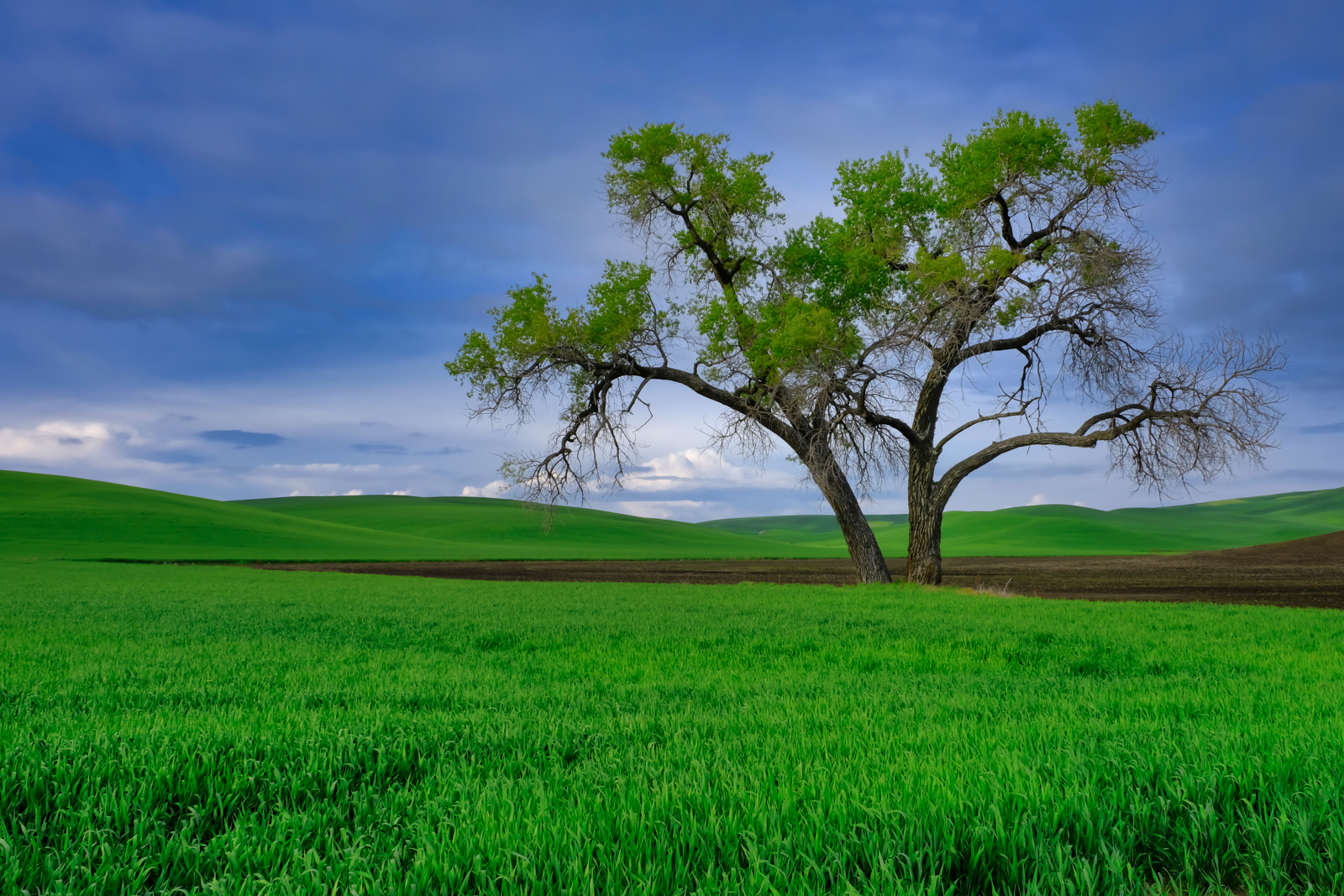
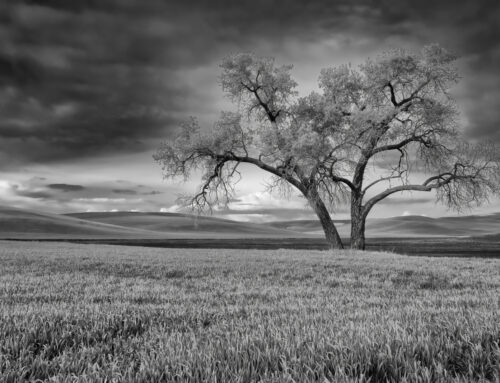
A few years ago, while scouting before a recent workshop in the Palouse region of Eastern Washington, I drove out to a familiar tree that I’ve been taking my clients to for quite a long time, the old oak tree. It’s a unique tree as it “double trunk” tree, not often seen. It stands alone in a field of wheat with a beautiful background. The tree had stood there for centuries, weathering storms, droughts, and generations of changing seasons.
A group of photographers, perhaps with another workshop company, gathered in position, looking at the double trunked oak tree in the field of almost mature green wheat. The tree had stood there for centuries, weathering storms, droughts, and generations of changing seasons.
Most of the photographers arrived carrying the latest cameras. Their backpacks are bulged with expensive lenses, some with drones, all the filters they could buy, batteries, tablets, and enough technology to rival a small television studio.
I took note of the conversation coming from one or two of the folks as they unpacked their equipment. The conversation quickly turned to megapixels, artificial intelligence autofocusses, dynamic range, noise reduction software, and the newest editing programs.
One photographer proudly announced that his camera could recognize over one hundred different subjects automatically. Another explained how his software could replace skies, remove distractions, and sharpen details that were never really captured in the first place.
While all of this was going on, I walked away. Frankly, it was hard to take.
 I was using my Fuji X-T4, a now 4-year-old camera with only 26.1 MP. It’s been around! I used my trusty 16-55mm F 2.8 lens. Since I was only scouting, I didn’t use my tripod. and had no camera bag full of gadgets.
I simply stopped and took my time to look at the old oak tree. For nearly about 15 minutes, maybe more, I did nothing but survey the landscape.
I noticed the morning clouds drifting through the landscape. I watched the sunlight slowly creeping out and the sky looking a bit more ominous every minute. I watched the sunlight illuminate the leaves hanging from the ancient branches.
Meanwhile, the other photographers were remarkably busy. Some were adjusting menus. Some were trying out different filters, and most were “playing” with their technology.
Others were reviewing images on their screen, zooming in to check sharpness at 400 percent magnification.
Very few were looking at the scene before them.
 After about 15 minutes of so, I raised my camera. I made only three exposures.
Then I admired the tree and the beautiful location one last time.
As I walked back to my car, one of the other photographers in the group must have noticed me. He walked over and asked, “How can you be finished already? I know he wanted to ask me questions like; “Don’t you need to bracket exposures, focus stack, shoot panoramas, and capture multiple versions for editing later?”
I just smiled and told him that. “I already made the photograph,”
The younger man looked confused. “You mean you already took the photograph?”
“No,” I replied. “I made it long before I pressed the shutter.
 What I did was spend time understanding the light, the tree, the atmosphere, and what attracted me to the scene. Pressing the button was the easiest part.”
I know that over the years, thousands of images capturing that tree have been forgotten. Technology has advanced. Cameras are now faster. Software has become smarter.
But, for me my photograph has endured. It was the simple image of the old oak tree glowing in the beautiful light. Nothing dramatic. Nothing artificial.
Just a beautiful moment, carefully observed.
The lesson of the old oak tree is one that many photographers seem to be forgetting.
Technology is a wonderful servant, but a poor master.
The fundamentals of nature photography have never changed. Light still matters. Composition still matters. Patience still matters. The ability to see remains far more important than the ability to process.
Nature does not care how many megapixels your camera has. The green wheat field in the Palouse does not care about firmware updates. The locations we visit do not care about artificial intelligence.
And the old oak tree certainly does not care what camera you carry.
What nature asks of us is much simpler. Slow down. Observe. Wait for the light.
And remember that the most important piece of equipment is always the photographer, not the camera.
All images and text are copyright Jack Graham and Jack Graham Photography LLC/ All rights reserved
Excellent article – very good advice that we, as photographers, should pay attention to in every shot.
Excellent article – very good advice that we, as photographers, should pay attention to in every shot.